Water Is the Biggest Problem Trees Face in Park City

Water Is the Biggest Problem Trees Face in Park City

In Park City, most tree problems are not caused by insects or disease. They are caused by a much simpler issue: water. More specifically, not enough of it reaching the roots of the Trees. With the many obstacles it has, trees are getting far less water than you think.

Most people have no idea, I know this because when I ask them how much water they’re giving the trees they give me a time period. Like 15 minutes, water, for the record is measured and volume not time. It’s a common mistake, but it tells me that they really don’t know how much the trees are getting and how damaging that can be.

Water out of the irrigation system has nothing but obstacles different ones in different seasons, but always present.

During summer, water is lost to evaporation, or absorbed by thick mulch near the surface, taken by surrounding grass, which is extremely competitive. Tree roots generally lie six to sixteen inches below the surface, and by the time water passes through mulch, turf, and compacted soil, very little remains.

Weed barriers often make things worse. While intended to suppress weeds, many fabrics become hydrophobic over time, especially when exposed to sun. Instead of letting water pass through, they deflect it away from the tree’s root system.

The situation deteriorates further in fall. Irrigation systems are typically blown out in early October, just when trees—especially spruce—should be storing water for winter. From October through November, trees receive little or no supplemental moisture. (the most critical time of the year) Then winter arrives.

In Park City, snow freezes and stays. From the first sustained snowfall through April, very little meltwater penetrates the soil. During this time, evergreen trees lose moisture to wind through transpiration, but cannot replace it because the ground is frozen. This leads to winter desiccation, leaving many spruce trees stressed and discolored by spring.

Roadside trees face an added challenge. Road salt pushed into planting areas raises sodium levels in the soil, which blocks water uptake and intensifies drought stress.

These issues are fixable, but they are rarely considered.. Fertilizer will not solve them. Trees in Park City don’t need more nutrients—they need better, more efficient water delivery. In a high-desert environment where water is precious, making sure it actually reaches tree roots is the single most important step toward healthier, longer-lived trees.


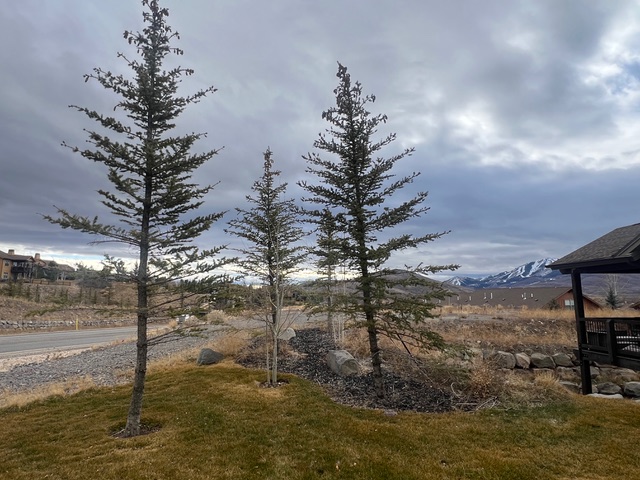
Weak trees (water deficient)
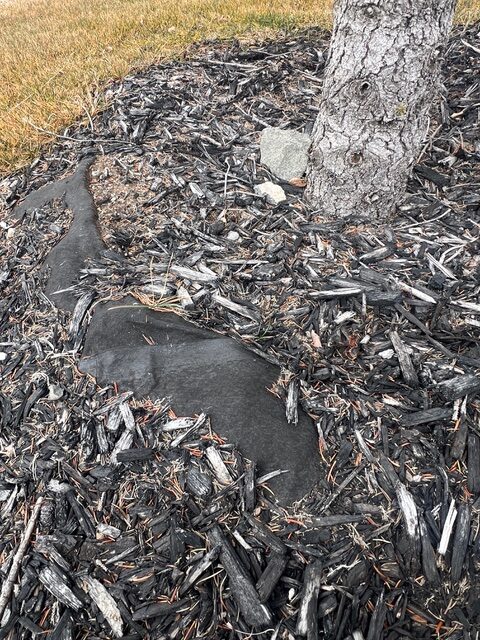
Large bark chunks

Why the Spruce Tree Struggles in Park City


The Aspen – Plant a Grove Not a Tree

The Aspen – Plant a Grove Not a Tree

When I’m called out to assess an Aspen in a new client’s landscape, it’s almost always planted as a stand-alone tree. That’s where the trouble begins.

Aspens are not meant to live alone — they’re communal by nature. Think of them like herd animals. If you’ve ever had a single horse kept in isolation, you understand: it gets anxious, deteriorates, and doesn’t thrive. Aspen trees behave the same way. They are genetically wired to live in communities — groves — and when isolated, they become exponentially more vulnerable to both biotic (living threats like pests and disease) and abiotic (non-living stresses like drought or heat) pressures.

In nature, Aspen groves form a connected root system. As the roots spread, they come into contact with other Aspen roots and begin fusing. This connection provides tremendous benefits — shared water, nutrients, and natural resistance to insects and pathogens. It even helps build a more resilient genetic diversity through the emergence of new clones. One Aspen tree standing alone doesn’t get any of this support — and it shows. Lone Aspen trees almost always decline prematurely, while groves can live for centuries.

In the landscape, however, we often treat Aspen as ornamentals. We plant them individually for their beautiful white bark and shimmering leaves, especially along driveways or as focal points. But that aesthetic decision usually sets the tree up for failure. Especially here in the Wasatch, where disease pressures are high, stand-alone Aspens are easy targets.

Aspens in our region frequently suffer from fungal issues like Marssonina or Septoria Leaf Spot — common but manageable in groves. The bigger threat is Cytospora Canker, which is devastating to single trees. Once the disease is established, there’s no synthetic cure available. Cytospora takes out well over half of the single Aspens I’m called to inspect, simply because they lack the natural support network of a grove.

We’ve developed a solution to Cytospora that works differently — not with synthetic chemicals, but with biology. I’ll share more about that another time.

The Takeaway:

Don’t plant Aspen trees. Plant Aspen groves.

A grove can tolerate loss because it’s constantly renewing itself through sucker shoots (called clones). If left alone, those clones will grow into new stems and help maintain the health and continuity of the group. Over time, the strongest genetics suited to your microclimate will dominate and thrive.

Aspen groves are incredibly resilient when allowed to function naturally. But one Aspen, alone in the landscape, is a tree waiting to fail.

Why So Many Voles in Park City?

Why So Many Voles in Park City?

Do Arborists get a Free Pass?

Do Arborists get a Free Pass?

Trees hold a very unique place in the hearts of people anywhere on the planet. People love trees because they embody the essence of life, beauty, and resilience. Trees provide shade on sunny days, clean the air we breathe, and serve as habitat for countless creatures, making them indispensable to our environment. Their wide roots and towering branches inspire awe and symbolize strength and stability, while their seasonal changes remind us of the cycles of life and renewal. Trees also evoke emotional connections—memories of climbing them as children, relaxing under their canopies, or planting one to mark a special occasion. Beyond their practical benefits, trees offer a sense of peace and connection to nature, serving as quiet witnesses to our lives and steadfast companions in an ever-changing world. This deep affection for trees often extends—sometimes too easily—to those who work with them: The Arborist.  


Because the love people feel for trees automatically spills over to anyone associated with their care. An arborist doesn’t have to do much to earn this admiration; it’s almost automatic. People assume that someone who works with trees must share their love for them. In a way, it’s as if the arborist inherits the goodwill that tree love naturally creates.  


That unearned respect can be a double-edged sword. On the one hand, it helps arborists build trust and rapport with clients more easily. People are inclined to believe that arborists have their trees’ best interests at heart, simply because they’ve chosen this profession. That should not be the case. The love for trees can and does become a shield for us from scrutiny or criticism, even when our methods or intentions do not align with the health and longevity of the trees we are hired to care for.


This automatic trust is (at times) not at all deserved in our industry. Not all arborists share the same dedication to tree health. Many may prioritize profit over preservation, offering services that are more about quick fixes with better margins (ex: unnecessary removals, Trunk Injections) than long-term care. Our solutions are increasingly about simplification, and margin. Yet, because people assume the best about anyone working with trees, these practices often go unchallenged.  

This phenomenon highlights the importance of looking beyond the label of “Certified Arborist” to ensure that the person entrusted with your trees genuinely understands and respects their needs. Trees may automatically grant arborists a share of their love and goodwill, but it’s up to the arborist to prove they are deserving of it through expertise, ethical practices, and true commitment to the health of the trees they care for.  

In the end, the love for trees should inspire both arborists and tree owners to work together to protect these majestic giants—not as a free pass, but as a shared responsibility.